
Mandatory marks
When an article of precious metal is placed on the market or sold, it must bear:
- a responsibility mark and fineness mark, or
- an Assay Office Mark and fineness mark.
Lightweight articles, in other words silver products weighing less than 10 g and gold, platinum and palladium articles weighing less than 1 g are an exception in that they are not required to have marks. If a lightweight product is marked, however, it must have at least a fineness mark. The fineness mark of a lightweight product does not need to indicate the precious metal in question.
Responsibility mark
The responsibility mark is a mandatory mark on an article of precious metal indicating the party responsible for the article. The responsible party means the manufacturer, importer or retailer of the article who must ensure that the article meets the legal requirements.
The party responsible for an article for sale in Finland can be traced based on the responsibility mark, as Tukes keeps a register of approved responsibility marks.
Articles of precious metals on sale in Finland must bear a responsibility mark registered with Tukes’ responsibility mark register, or alternatively an Assay Office Mark.
The responsibility mark is a capital letter, or a combination of several capital letters, that identifies the responsibility mark holder. A responsibility mark registered before 2001 may contain an image or lowercase letters and punctuation marks, which can no longer be registered.
For more information and instructions for applying for a responsibility mark, visit the How to apply for a responsibility mark page.
Marks going back more than 50 years can be found on the www.leimat.fi website.
Fineness mark
The fineness mark consists of two different elements, which indicate the precious metal in question and its fineness.
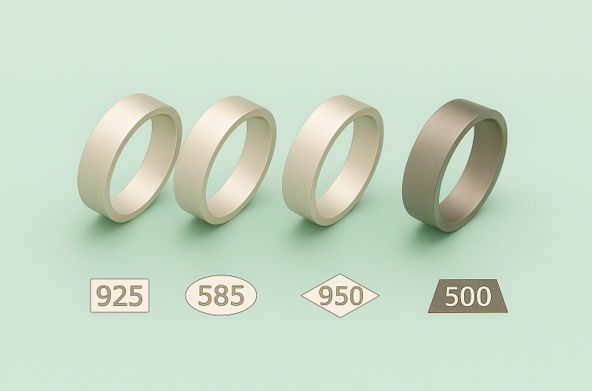
Caption: Without marks, would you know which metal these rings were made of?
Base shape or chemical symbol
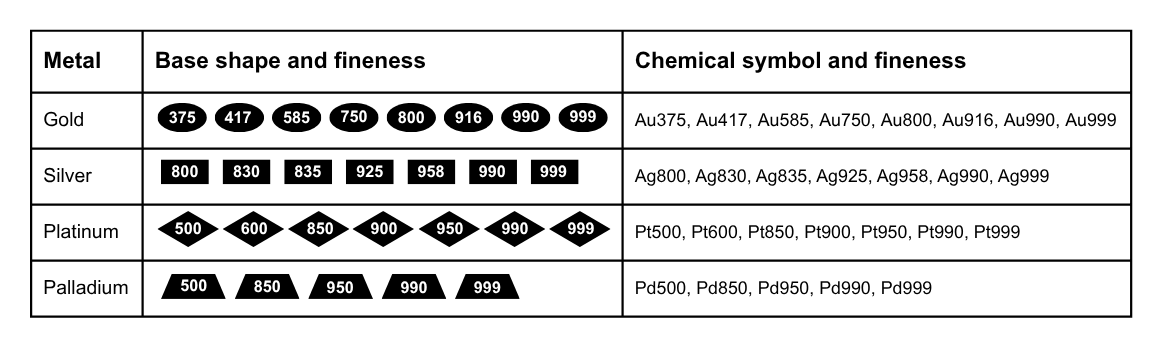
Either a base shape or the chemical symbol for the precious metal is used in the fineness mark to indicate the precious metal in question. The chemical symbol is the primary choice.
For example, if you import products whose fineness mark shape differs from the one approved in Finland, you can correct it by marking the article with the chemical symbol indicating the precious metal in question.
The image below shows the base shape used for each precious metal or the alternative chemical symbol. The series of numbers in the fineness mark indicates the fineness of precious metal in parts per thousand by mass.
Exceptions:
- The chemical symbol or base shape can be left out if marking would damage the article or is not possible due to lack of space.
- If a lightweight article is marked (a silver product of less than 10 g and other precious metals of less than 1 g in weight), it must have at least the fineness mark. The fineness mark is not required to have a chemical symbol or base shape.
The three-digit number of the fineness mark indicates the minimum fineness of precious metal in the alloy used for the article. For example, if the fineness mark of a silver article reads 925, this indicates that the article in question contains at least 92.5% of pure silver. In a silver article of this type, you can use a fineness mark with the number 925 in a rectangular baseor the marking Ag925 without a base shape.